
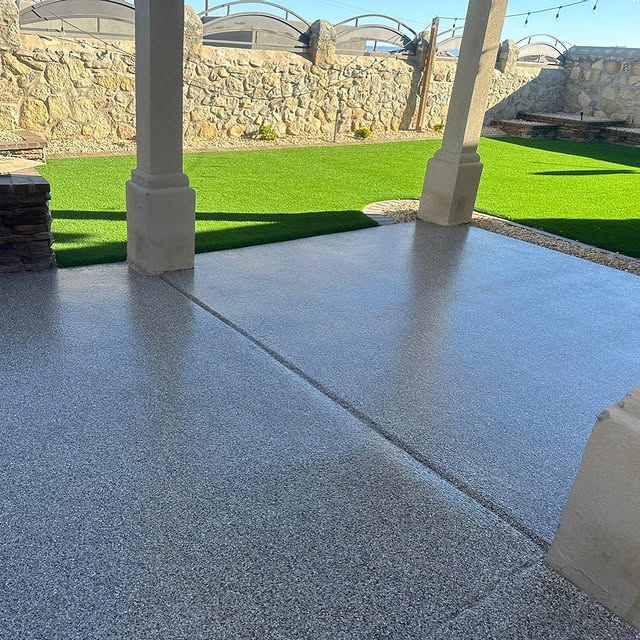
Can You Put Epoxy on an Outdoor Patio?
Yes, you can coat an outdoor patio, but not with straight epoxy. Standard epoxy isn’t UV-stable, and in direct sun it yellows, fades, and eventually chalks. Out here that can happen in a matter of months, not years. What holds up outdoors is a UV-stable aliphatic topcoat, usually polyaspartic, installed over a properly prepped slab. That’s the system we put on patios and outdoor concrete all over El Paso, and it’s the short answer to a question we get almost every week.
So the real question isn’t “can you epoxy a patio.” It’s “what do you put on top of it so the sun doesn’t wreck it.” Let’s walk through that.
Does Epoxy Yellow in the Sun? Yes, and Faster Than You’d Think
Most epoxies are built on aromatic chemistry, which is a fancy way of saying UV light breaks them down. The resin ambers first, so a clear coat goes yellow and a light gray floor starts looking like weak tea. Keep the sun on it and the surface chalks, meaning it turns dull and powdery and wipes off on your hand.
Spend ten minutes on any garage or car-restoration forum and you’ll find the same story on repeat: someone coats an outdoor slab or a garage apron with epoxy, and by the end of the first summer the exposed section has turned amber while the shaded part still looks new. Indoors, epoxy is a fine product. Outdoors in full sun, it’s the wrong tool, and no amount of extra coats fixes the chemistry.
We won’t install straight epoxy as a finish coat outdoors here. Period.
What Actually Works on an Outdoor Patio
A UV-stable aliphatic polyaspartic topcoat
Aliphatic polyaspartics and urethanes are formulated to shrug off UV. They don’t yellow, they flex a little with temperature swings, and they wear harder than epoxy at the surface. On patios we either run a full polyaspartic system or an epoxy base with a polyaspartic topcoat, where the epoxy does the bonding work down low and the polyaspartic takes the sun. Major manufacturers like Sika build their exterior flooring systems the same way, with the UV-stable layer on top. If you want the deeper comparison between the two chemistries, we broke it down in our polyaspartic vs. epoxy guide.
Flake systems with real texture
For patios we usually recommend a full-flake system: vinyl flakes broadcast into the base coat, then locked under the clear polyaspartic. The flakes hide dust between cleanings, which matters here, and they hide the small imperfections every older slab has. The broadcast also leaves a light orange-peel texture, so the surface has grip when monsoon rain or pool splash hits it instead of turning into a slide. If you need more bite, we can add aluminum oxide grit to the topcoat, but for most patios the flake texture is enough.
The El Paso Part: 300+ Days of Sun and a Slab That Bites Back
El Paso gets over 300 days of sunshine a year, and our summer UV Index regularly sits in the “very high” to “extreme” bands on the EPA’s UV Index scale. A patio has zero shade structure protecting the coating in most yards. Whatever you put down is getting the full dose, every day, at 3,800 feet of elevation.
Heat is the other half of it. Last June we did a west-facing patio up in the Franklin Mountains foothills on the west side, the kind of yard that stares straight into the afternoon sun. The homeowner had rolled on a DIY epoxy kit two years earlier, and it had gone from light gray to a blotchy amber in about eight months. When we came out to redo it, the slab surface read 138°F at 2 p.m. You can’t coat concrete that hot, so we started at sunrise and were cleaned up before the slab crossed our cutoff temperature. That’s normal summer scheduling here, not a special favor.
Monsoon season adds one more wrinkle. Moisture driving up through an outdoor slab can blister a coating that was applied over a damp surface, so we check moisture before we ever open a pail. Sun, heat, water, dust. The desert tests every shortcut.
Prep on an Outdoor Slab Is Half the Job
Outdoor concrete has usually lived a harder life than a garage floor. Before anything goes down, we diamond-grind the whole surface to open the pores, because outdoor slabs are often troweled slick or have decades of grime pressed into them.
Two things need special attention. First, cracks. Temperature swings here move concrete more than people expect, so cracks get chased out and filled with a flexible or rigid repair material depending on what they’re doing. We covered the how and why in our post on fixing cracks before coating. Second, old sealers. A lot of patios were sealed with a cheap acrylic at some point, and any coating applied over that will peel with it. Grinding takes it off; skipping that step is how you end up doing the job twice.
When We’d Tell You Not to Coat Your Patio
Sometimes the right answer is “not yet,” and occasionally it’s “not at all.”
If your slab is badly spalled, meaning the top layer is flaking off in sheets or popping in chunks, a coating won’t glue it back together. It needs resurfacing or repair first, and we’ll tell you that on the estimate instead of coating over a failing surface and cashing the check. And if your budget is porch-and-patio paint from the hardware store, we’re honestly not your guys. That paint will look decent for a season and then peel and fade in this sun, but it costs $50, and some folks are fine repainting every year or two. No hard feelings. Just know what you’re buying.
One more note since people ask: patios don’t see hot-tire pickup the way garage floors do, so that particular failure mode isn’t the worry out back. The sun is.
What a Patio Coating Costs and How to Get a Real Number
Coating work in our area runs somewhere between $4 and $13 per square foot depending on prep and system. A typical 300 sq ft patio with average prep and a full-flake polyaspartic system usually lands in the middle of that math, but a slab with heavy crack repair or an old sealer to grind off moves the number. Nobody can quote your patio accurately without seeing it, and you should be suspicious of anyone who tries.
If you’ve got a patio and you’re weighing options, Epoxee will come look at it and give you a straight answer, including “fix the slab first” if that’s the truth. Request a free estimate at epoxee.com/quote, grab a time directly at epoxee.com/book, or call us at (915) 493-0667.