
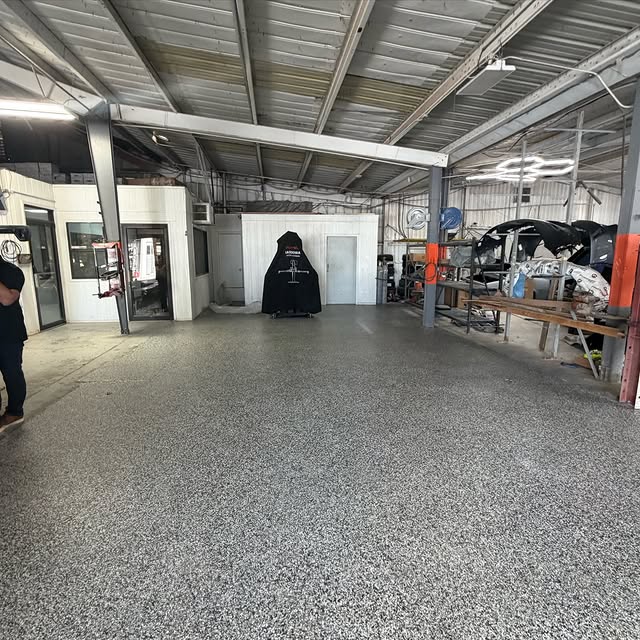
How Long Before You Can Park on Your New Epoxy Floor?
Here’s the short answer up front: with traditional epoxy, wait at least 72 hours before you park on your new epoxy floor, and most installers, us included, will tell you 3 to 5 days to be safe. With a polyaspartic coating, you can park in 24 hours. Walking on it happens much sooner: about 24 hours for epoxy, just 2 to 3 hours for polyaspartic.
That gap catches people off guard. The floor feels dry the next morning, so they figure it’s done. It isn’t. “Dry to the touch” and “cured” are two different things, and the space between them is exactly where tire marks come from.
The Cure Timeline: Walking, Shelving, Parking, Full Cure
Numbers first, explanations after. These assume a normal garage install at reasonable temperatures. We’ll get to weather in a minute, because in El Paso it matters more than most people think.
| Milestone | Traditional epoxy | Polyaspartic |
|---|---|---|
| Light foot traffic | 24 hours | 2–3 hours |
| Shelving, toolboxes, storage | 48–72 hours | Next day |
| Parking a vehicle | 72 hours minimum; 3–5 days recommended | 24 hours |
| Full chemical cure | 5–7 days | Days, not a week; drivable at 24 hours |
When Can You Park on Your New Epoxy Floor in El Paso?
Bare minimum with epoxy: 72 hours. Our honest recommendation: 3 to 5 days. Some manufacturers go further and say a full week, and if the weather’s cool, we agree with them. And if an installer tells you “24 hours” without asking whether you mean feet or tires, ask again, because 24 hours is a foot-traffic number, not a parking number.
The reason is how epoxy hardens. It cures from the surface down, so the top skins over and feels rock hard while the material underneath is still soft. A 4,000-pound truck then concentrates all that weight onto four small patches of warm rubber. If the coating under those patches hasn’t finished crosslinking, the tires slowly press in and leave imprints that don’t bounce back.
Polyaspartic plays by different rules. It’s built for speed, which is why it takes vehicle traffic in 24 hours; even Rust-Oleum’s FinishKote 70 spec sheet puts vehicle traffic at 24 hours when it’s 77°F or warmer, and 48 hours below that. An El Paso summer garage is never below 77°F, so around here polyaspartic is always in the fast lane. That speed is one of the main reasons we install polyaspartic on most El Paso garages.
Can I Walk on It After 24 Hours?
With epoxy, yes, lightly. Socks or clean shoes, not work boots with gravel stuck in the tread, and keep the dog off it one more day since claws are pointier than sneakers. With polyaspartic you’re walking on it the same afternoon, usually 2 to 3 hours after the final coat.
One request we make of every customer: don’t “test” it with a fingernail. If it needs testing, it needs waiting.
When Can I Put My Junk Back in the Garage?
Everybody asks this one, usually in exactly those words. For epoxy, give it 48 to 72 hours before the shelving, toolboxes, and bikes come home. Carry things in rather than dragging them; a steel shelf leg dragged across a 90-percent-cured floor will gouge it in a way a fully cured floor would shrug off. Polyaspartic customers can usually load back in the next day, which matters more than you’d think when the entire contents of your garage are sitting in the driveway under a July sun.
What Happens If You Park on Epoxy Too Early?
Tire imprints, mostly. Last winter a homeowner up in Northeast El Paso, off Hondo Pass, called us about a floor he’d coated himself. The kit said 24 to 72 hours, he split the difference, and his truck sat on it overnight on day two. The result was four cloudy, tire-shaped patches pressed a hair deep into the surface, right where the wheels had rested. Cold nights had stretched the cure time, and nothing on the bucket warned him.
Shallow marks sometimes fade a little as the floor finishes curing. Deep ones don’t, and the fix usually means sanding and recoating the affected area, the same process we walk through in our post on fixing a peeling epoxy garage floor.
Parking early also sets the stage for hot-tire pickup later on, a failure mode we break down in our epoxy vs polyaspartic comparison.
Does Weather Change Epoxy Floor Cure Time?
Cure is chemistry, and chemistry runs on temperature. A summer install here is on the early end of every range: slab surface temps over 100°F push the reaction along quickly. Winter flips it. The desert drops hard after sundown, and an unheated garage in January can sit in the 40s all night. A cool-weather epoxy install can genuinely need a full week before a car should touch it. Polyaspartic slows down too, closer to 48 hours for vehicles in the cold, but that still beats epoxy’s cold-weather week by a wide margin.
One more caveat: if your slab itself was just poured, the coating timeline isn’t your problem yet. New concrete has to cure and dry out before any coating goes down, something Sherwin-Williams covers in their technical article on coating green concrete. Coat too soon and trapped moisture will push the finish right back off.
Want a Floor You Can Park On Tomorrow?
If a week of cars in the driveway sounds like a dealbreaker, that’s the strongest practical argument for polyaspartic, and it’s the system behind most of the garage floor coatings we install. Epoxee crews finish a typical two-car garage in one to two days, and you’re parking the next morning. Get a free quote, book a visit, or call (915) 493-0667 and we’ll tell you exactly what your timeline looks like.