
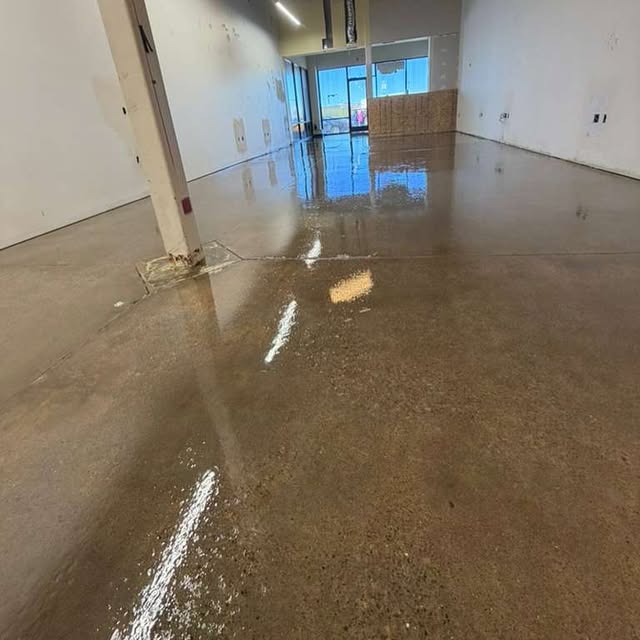
How Soon Can You Epoxy New Concrete in El Paso?
If you just had a slab poured and you want to know how soon you can epoxy new concrete, here’s the short version: plan on a minimum of 28 days of cure before anyone coats a new slab, and understand that 28 days is a floor, not a promise. Depending on the mix, the weather, and what sits under the slab, the real wait can stretch to 60 days or longer. The only honest way to know is to test the slab for moisture in several spots and read the numbers.
We get this call constantly from builders and homeowners out in Horizon, the far East Side, and the Northeast, usually a week or two after the concrete crew pulled off the job. The floor looks great. It’s pale, it’s hard, you can walk on it in your socks. That tells you almost nothing about whether it’s ready for a coating.
Why Can’t You Epoxy New Concrete Right Away?
Concrete doesn’t dry the way a wet towel dries. It cures, and it keeps pushing water vapor up out of the slab long after the surface feels bone dry. Sherwin-Williams says it plainly in their technical guidance on green concrete: standard specifications recommend a minimum 28 day cure period before an epoxy floor coating or other resinous system can be applied, but that is only a guideline, and the actual waiting period can be much longer depending on the composition of the concrete mix, the relative humidity, air temperatures, and a host of other conditions. Their write-up on coating freshly poured concrete is worth ten minutes if you’re the type who wants the manufacturer’s own words.
Coat it too early and the resin seals that moisture under a film with nowhere to go. You get bubbles, blisters, and sheets of coating letting go of the slab. We have been called out to fix exactly that, and it is not a touch-up job. Once a coating delaminates off a wet slab you are grinding the whole floor back to bare concrete and starting over.
How Do You Know When a New Slab Is Ready?
New concrete looks dry well before it’s ready, and moisture doesn’t sit evenly across a floor. The middle of a two-car garage can read completely different from the strip by the door. That’s why testing one spot is worthless. We test several areas of the slab, and we do it after the slab has had its 28 days, not before.
The Three Tests That Actually Tell You
Relative humidity probes (ASTM F2170)
Holes get drilled into the slab and probes go in, so you’re reading the internal relative humidity of the concrete instead of the surface. A result under 80% RH is generally accepted by most resinous flooring manufacturers. This is the test we trust. Decades of research on both sides of the Atlantic point the same direction: internal RH is the most reliable way to read the moisture condition of a concrete floor slab, and that lines up with what we see in the field.
Calcium chloride test (ASTM F1869)
A dish of calcium chloride sits sealed to the slab for 60 to 72 hours and gets weighed to calculate how much moisture the concrete is giving off. Most manufacturers require a result under 3 lbs per 1,000 sq ft per 24 hours. Test areas go roughly 1,000 sq ft apart, and each spot has to be opened by grinding or shot blasting first, because a hard-troweled surface reads low and lies to you.
Plastic sheet test (ASTM D4263)
Tape a heavy plastic sheet at least 12 inches by 12 inches to the concrete, leave it 24 hours, then pull it up. Condensation underneath or darkened concrete means the slab is still too wet. It’s cheap, it takes a day, and anybody can run it. It’s also the least precise of the three and some warranties won’t accept it as proof. Treat it as a quick screen, not a green light.
Does El Paso’s Dry Air Shorten the Wait?
Some. El Paso runs 300-plus days of sun and low ambient relative humidity most of the year, and a slab in that air gives up moisture faster than a slab sitting on the Gulf Coast. In practice we do see El Paso slabs test clean closer to the 28-day mark than the 60-day outside number. Drying faster is not the same as being ready, though, and we still test.
Four local things push the wait back the other direction:
- Monsoon season. From roughly July through September we get humid days and hard rain dropped straight into the drying window.
- Caliche subgrade. Pour over damp caliche with a thin vapor barrier or none at all and the slab keeps getting fed from below, no matter how dry the air above it is.
- Slabs left open. New-construction garages in the far East Side and Horizon subdivisions sit for weeks with no roof over the pour or nothing but a tarp across the door opening.
- Temperature swings. A 35-degree spread between afternoon and 5 a.m. moves vapor around inside the slab, so one reading taken at 4 p.m. in August is not the whole story.
Last summer a builder called us about a spec home off Eastlake in Horizon City. Slab poured mid-July, door opening tarped, and two monsoon storms rolled through the week after the pour. At three weeks he wanted it coated so it wouldn’t hold up his schedule. We probed it and got 88% RH. We came back three weeks later and it read 74%. That garage got coated in September and it’s holding fine. Had we put a coating down in July to protect his calendar, he’d have been paying somebody to grind it off by Christmas.
Can You Coat Sooner With a Moisture-Tolerant System?
Yes, and we’ll be straight about the trade. Moisture-mitigating primers and breathable systems exist, and some manufacturers say they can go down as early as 7 days after the pour. They cost more, they add a step, and they are not what a standard residential garage package includes. On a commercial floor with a hard opening date, that math often works out. On a homeowner’s two-car garage we would usually rather you wait the month and put the money into the wear layer instead. Either way the number moves with prep and system: coatings here run roughly $4 to $13 per square foot installed, or about $1,600 to $6,500 for a typical 400 to 500 sq ft two-car garage.
Two Things That Fail a New Slab Even After It Dries
Curing compounds and sealers. Plenty of concrete crews spray a cure-and-seal on a fresh pour. Good for the concrete, terrible for adhesion. We flick water across the surface, and if it beads up instead of soaking in, something is on there and it has to come off by grinding or shot blasting before any coating touches it.
Cracks and slab defects. New slabs crack. Shrinkage cracks show up inside the first month all the time, and they have to be filled and stabilized before coating, not patched after. We wrote a full piece on fixing cracks in concrete before an epoxy coating, and when a slab has bigger problems than hairlines, repair and resurfacing has to come first.
How Long After Coating Can You Park on It?
Different question with a much shorter answer: the wait before we coat is measured in weeks, and the wait after we coat is measured in days. We broke that timeline down in when you can park on your new epoxy floor.
When We’d Tell You Not to Hire Us Yet
If your slab is nine days old and you want a standard system on it next week, we’re going to turn the job down. Not because we don’t want the work. Because we’d be installing a warranty claim and we both know it. If you want to understand what’s still going on inside a young slab, the American Concrete Institute’s material on curing concrete covers it well. Give the slab its 28 days, let us test it, and if the numbers say go, we book it.
Get Your New Slab Tested Before You Coat It
Epoxee installs garage floor coatings across El Paso, Horizon City, Las Cruces, and the rest of far West Texas, and we test new pours before we quote them. If you’ve got fresh concrete and you want to know where it actually stands, call Epoxee at (915) 493-0667 or request a quote and tell us the pour date. We’ll give you a straight answer on whether it’s time yet.