
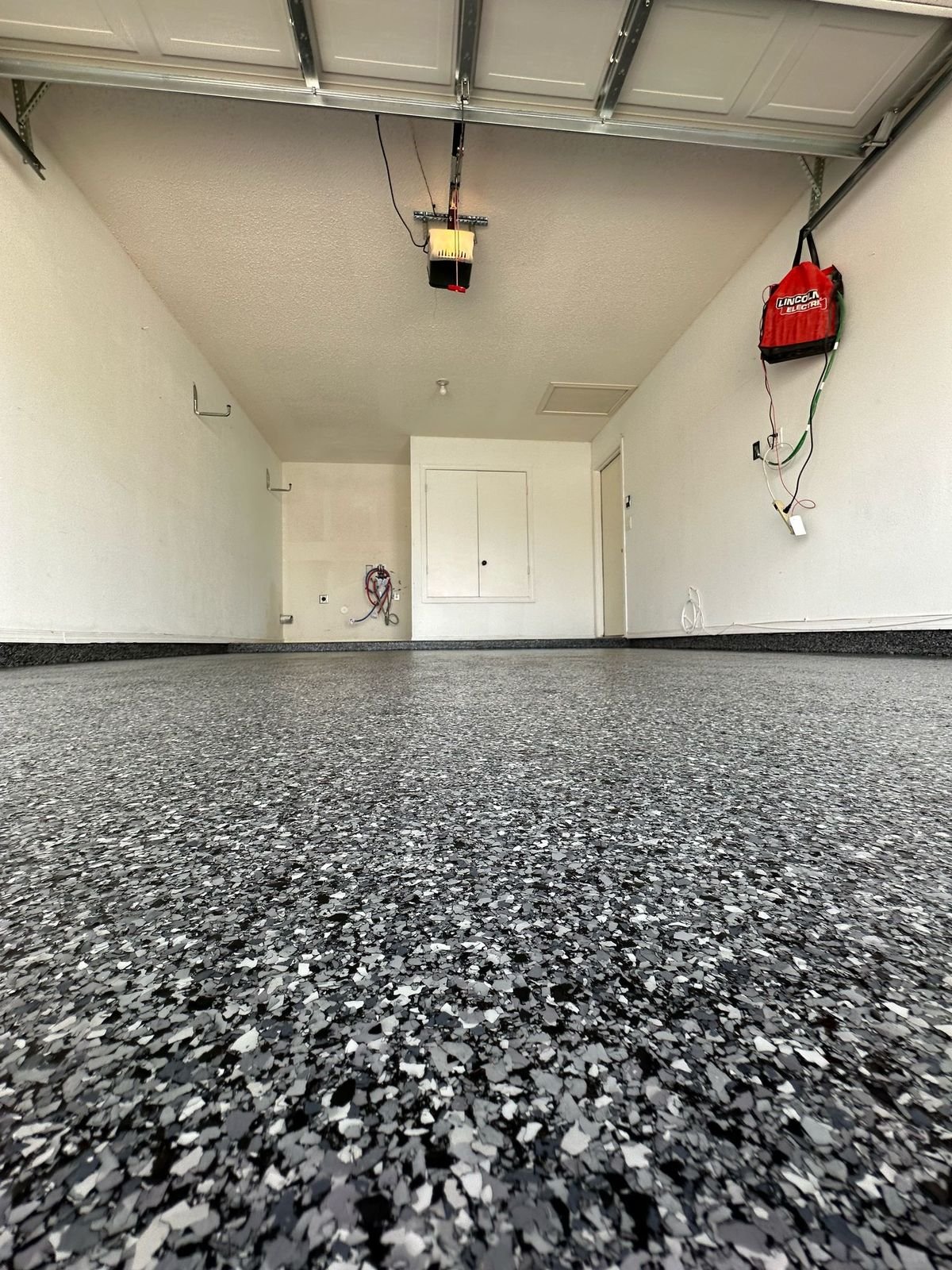
Epoxy Garage Floor Home Value: The Honest Answer
The honest answer on epoxy garage floor home value is that a coated floor almost never shows up as a dollar figure on an appraisal, but it does change how fast a house moves and what buyers think the second they walk in. Nobody’s going to open your garage door, see a gray and white flake floor, and write a line item for it. We’re Epoxee, we coat garage floors in El Paso for a living, and we’re still telling you the appraiser won’t add a dollar. What the coating does is different: it makes the garage read as finished and gives a buyer one less thing to deduct in their head.
What the remodeling data says about epoxy garage floor home value
Here’s the part nobody selling these floors likes to bring up. The 2025 Remodeling Impact Report from the National Association of Realtors and NARI ranks projects by how much of the cost owners recover at sale. A new steel front door recovers 100 percent. A closet renovation, 83. A fiberglass front door, 80. A complete kitchen, 60.
Garage floor coating isn’t on that list. Not in cost recovery, not in the Joy Score table where projects average 8.2 and a garage door scores 7, not in the work Realtors recommend before selling. It isn’t rated low. It isn’t rated at all.
Compare that to the garage door. Zonda’s 2025 Cost vs. Value Report puts garage door replacement at number one in the country for the second straight year: about $4,672 to install, $12,507 in resale value, 268 percent recouped, and 270.3 percent in the West South Central region that includes Texas. The door gets measured every year and it pays. The floor underneath it has never been measured.
Will an appraiser add value for a coated garage floor?
Almost certainly not. The reason is mechanical, not aesthetic. Fannie Mae’s Selling Guide, in section B4-1.3-03 on the neighborhood section of the appraisal report, tells an appraiser to comment on over-improvements and to reflect only their contributory value in the sales comparison adjustment grid. Contributory value means what the local market has demonstrably paid for a feature, proven with paired sales of comparable homes.
Think about what that requires. To adjust your appraisal upward for a coated garage floor, an appraiser needs recent comparable El Paso sales where one home had a coating and one didn’t, close enough in every other respect that the price gap can be pinned on the floor. That data doesn’t exist here. The adjustment lands at zero, not because the floor is worthless, but because there’s nothing to measure it against.
Homeowners on garage forums have been saying this for years, and they’re right. One posted that most of an appraisal’s value comes from the home, and that a coating “will add appeal for a small fraction of buyers but not a significant factor for value.”
Does a coated garage floor help a house sell faster in El Paso?
A coating can shorten the time to sell even when it does nothing to the sale price, and that’s the argument worth taking seriously. A homeowner on a garage forum put it well: if the property is costing you money every month in payments, insurance and taxes, reducing the time to sell is the same as increasing your net. That’s the right frame, not what it’ll appraise for, but what another three weeks costs you.
The local number makes it concrete. Median days on market across the El Paso metro has sat at about 65 days for July, June and May of this year, with 55 in April and 57 in March. Call it two months of mortgage, insurance, taxes and utilities on a house you’ve already emotionally left.
El Paso adds its own wrinkle. Most buyers here walk into the house through the garage, because that’s how a showing goes when the agent parks in the driveway. With 300 plus days of sun and monsoon dust working under the door every summer, a bare slab in this town reads dirty even when it’s clean. Oil shadows under the parking spots, efflorescence along the edges, tire marks by the threshold. That floor is the first surface a buyer sees.
Does a garage floor coating raise your property taxes?
Not in any way you’re likely to notice, and people mix up three different numbers here. Assessed value is what the county uses to calculate your tax bill. Appraised value is what a licensed appraiser reports to a lender. Market value is what a buyer will actually pay. A garage floor coating isn’t a permitted structural change, it adds no square footage, and it isn’t something the appraisal district is out measuring.
Is it worth coating the garage floor before you list?
Sometimes yes. It turns on your timeline and your slab. If you’re listing in three weeks and the garage is the worst room in the house, a coating is one of the cheaper ways to make it stop being the worst room. If your garage already looks fine and you’re listing to move on, put that money in the front door instead, because the data says the door pays and the floor doesn’t. Budget somewhere between $4 and $13 a square foot depending on prep and system, roughly $1,600 to $6,500 for a typical 400 to 500 square foot two car garage.
An installer in that same thread said his customers are mostly people just moving in and people preparing a house to sell, and that many of his leads come from realtors. That matches what we see.
What actually pays back in a garage
If resale is your only goal, spend in this order. Garage door first, by a long way. Then lighting, because a dim garage looks smaller and dirtier than it is. Then drywall repair and paint, which is cheap and photographs well. Then overhead storage. On a pure resale spreadsheet the floor sits after all of that.
Where the floor jumps the line is when you’re staying. That’s the honest split. Garage floor coatings pay you back in daily use: no dust, no oil stains, hose it out and it looks new again. We covered how long an epoxy garage floor lasts in this climate separately, and the short version is that a properly prepped polyaspartic system outlives most of the reasons people move.
The sales pitches worth walking away from
A homeowner posted about an installer who claimed an 8 percent increase in resale on a $3,000 floor. On his house that math implied a $32,000 bump. His reaction: “That alone told me to question the installer.” Good instinct. No published cost recovery dataset includes garage floor coating at all, so any percentage a salesperson quotes you was invented on the spot.
He also walked partly because the lifetime warranty covered only the original purchaser. Read that again in a resale context. A non transferable lifetime warranty is worth nothing in the exact scenario the salesperson is using to close you.
And cost isn’t value. Only one project on that 2025 list recovers 100 percent of what it cost.
What we’d tell you standing in your garage
We coated a garage in the Northeast this spring, a 1970s house up off Rushing Road, owners listing in six weeks. Two decades of oil under the parking spots and a hairline crack across the bay. Grind, patch, flake broadcast, polyaspartic topcoat, done in a day and a half. That garage went from the room they apologized for to the room the agent shot first. Did it move the appraisal? No. Did it stop being a negotiating chip? Yes.
Here’s when not to call us. If you list next week and your slab needs moisture testing or real crack repair, we’d be rushing prep to hit your date, and rushed prep is how coatings fail. If your front door is original and sun beaten and the budget is thin, fix the door first. If you’re selling a rental you’ll never set foot in again, skip the floor. We’d rather say that now than take a job you resent later, which is a fair summary of how we work.
If you’re staying put and you want the garage to stop being the room you close the door on, that’s the job we’re good at. Get a free quote from Epoxee or call (915) 493-0667 and we’ll walk your slab, tell you what it needs, and tell you straight if it isn’t worth doing.