
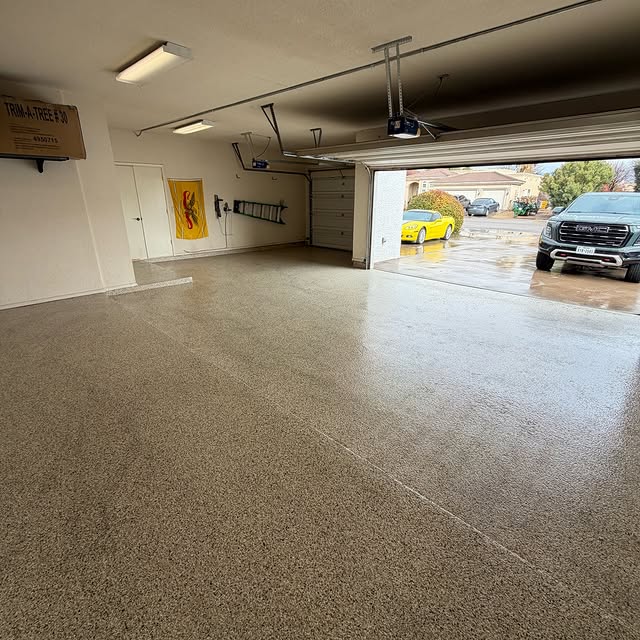
How Long Does an Epoxy Garage Floor Last in El Paso?
How long does an epoxy garage floor last? Honest answer: anywhere from two years to twenty-plus, and that spread is exactly why the question is worth asking before you spend a dime. A professionally installed system over properly ground concrete, finished with a UV-stable topcoat, routinely runs 10 to 20 years in a residential garage. A thin hardware-store kit rolled over dusty, unground concrete can start peeling before your tires need rotating. We’ve coated hundreds of garages around El Paso, and the difference almost never comes down to luck. It comes down to prep, product, and what your floor lives through.
How Long Does an Epoxy Garage Floor Last? The Real Ranges
Standing in your garage, here’s how we’d break it down:
- Professional multi-coat system (diamond-ground slab, epoxy or polyaspartic base, full flake broadcast, wear topcoat): 10 to 20+ years in a typical home garage.
- Contractor install without a wear topcoat: usually 5 to 10 years before the traffic lanes dull out and wear through.
- Big-box DIY kit: often 1 to 3 years, sometimes less if the slab was only acid-etched or had oil soaked into it.
- Commercial and shop floors: forklifts, chemicals, and dropped tools cut every one of those numbers down. Usage is its own variable.
That last point deserves more respect than it gets. A garage that stores a golf cart and Christmas decorations can outlast a daily-driver, project-car, floor-jack garage by a factor of ten. Same product, same installer, wildly different life. So when somebody quotes you one tidy number, they’re guessing.
What Makes an Epoxy Floor Fail Early
Three culprits show up over and over when we get called to look at a floor that didn’t make it past year three.
Prep shortcuts
Coatings don’t fail in the middle of the coat; they fail at the bond line. If the concrete wasn’t mechanically ground to open up the surface, the epoxy is sitting on top of the slab instead of gripping into it. At Epoxee we grind every floor with diamond tooling before anything goes down, because no resin on earth fixes a bad bond.
Moisture in the slab
Concrete breathes. When vapor pushes up from below, it lifts the coating off in blisters and sheets, and around here monsoon season finds every slab that never got a moisture check. A quick test before install is cheap insurance against a floor that fails from underneath.
UV exposure
Standard epoxy ambers and chalks in sunlight. If your garage door faces west and stays open on weekends, the strip nearest the door will yellow first. It’s a cosmetic failure before it’s a structural one, but it’s the reason topcoat chemistry matters so much in the desert.
Pro Install vs. a DIY Kit: Two Different Clocks
Walk into any hardware store and you’ll find something like the Rust-Oleum EpoxyShield garage kit for the price of a nice dinner out. It’s real epoxy, but it’s one thin water-based coat with no wear topcoat, and the prep instructions amount to a citric-acid etch and a good sweep. That’s why the kits so often give out in 1 to 3 years while a professional system is just getting broken in. If yours is already lifting, we wrote up how to fix a peeling epoxy garage floor so you can decide whether it’s salvageable.
The money side, since it’s fair to ask: a professional install runs somewhere between $4 and $13 a square foot depending on prep and system, so a typical 400 to 500 square foot two-car garage lands between $1,600 and $6,500 installed. Doing it once at that price beats doing it three times at kit prices, but only if the installer earns the difference with real prep.

The El Paso Factor: Sun, Heat, and Hard-Working Slabs
Our sun is not a marketing line. El Paso sees 300+ days of it a year, and the UV index here sits in the high-to-extreme range for a good chunk of the calendar. That UV load is what turns cheap epoxy yellow and chalky, and it’s why we finish garages with an aliphatic polyaspartic topcoat that shrugs off sunlight instead of absorbing it.
Sun is only half of it. Desert slabs swing hard between a 105-degree afternoon and a 60-degree night, and that expansion-contraction cycle works a coating like bending a paperclip. Add wind-blown grit acting as sandpaper under your tires and the occasional monsoon soaking, and a floor here earns its keep in a way a garage in Ohio never will.
One of the earlier polyaspartic garages we did sits on the west side near Coronado Country Club, with a west-facing door that takes the full afternoon blast. It’s coming up on eight years now, and when the homeowner had us out to quote his patio last spring, the garage flake still read crisp, no ambering at the door line. Right system for the exposure. That’s the whole trick.
Maintenance That Buys You Another 5 to 10 Years
Nobody wants a floor with a chore list, and honestly a coated floor barely has one. But the few habits that matter, matter a lot. Clean with a pH-neutral cleaner instead of degreasers or citrus strippers, which slowly dull and soften the topcoat. Wipe up oil and brake fluid when you see them rather than letting them sit for a month. If you pressure wash, keep it under 1200 PSI. Do that much and industry experience says you add 5 to 10 years to the useful life of the system.
The first week matters too. A fresh coating needs a few days to reach full hardness, so give it that time before the daily drivers and floor jacks move back in.
Recoat or Redo? How to Tell
Not every tired floor needs to start over. If the coating is dull, scratched, or worn thin in the drive lanes but still bonded tight, we can scuff it and apply a fresh topcoat for a fraction of the original cost, and the clock resets. If it’s peeling, blistering, or flaking off in chips, the bond is gone and the honest fix is grinding it all off and rebuilding the system. Recoating over a failing bond just gives the old coating something new to take down with it. When we look at epoxy floor repair jobs, that bond check is the first thing we do, and we’ll tell you straight which side of the line you’re on, even when the answer is the cheaper one for you and the smaller ticket for us.
Does Polyaspartic Last Longer Than Epoxy?
As a topcoat, yes, and it’s not close in our climate. Polyaspartic is UV-stable, more abrasion-resistant, and more flexible through temperature swings, which is why our standard garage floor coating is a 1 to 2 day install pairing a high-build base with a polyaspartic wear surface. It also resists hot-tire pickup far better than bare epoxy, which we dug into in our polyaspartic vs. epoxy comparison.
Short version: epoxy builds the body, polyaspartic protects it. In El Paso sun, skipping the second half is how 15-year floors become 5-year floors.
Get a Floor That Outlasts the Truck Parked on It
If you want a real number for your garage instead of a range on the internet, we’ll come look at your slab, check for moisture and old sealers, and quote it honestly. Request a free estimate at epoxee.com/quote, grab a time that works at epoxee.com/book, or call us at (915) 493-0667. Most two-car garages are done in a day or two, and built to still look good when the truck it’s under has been traded in twice.