
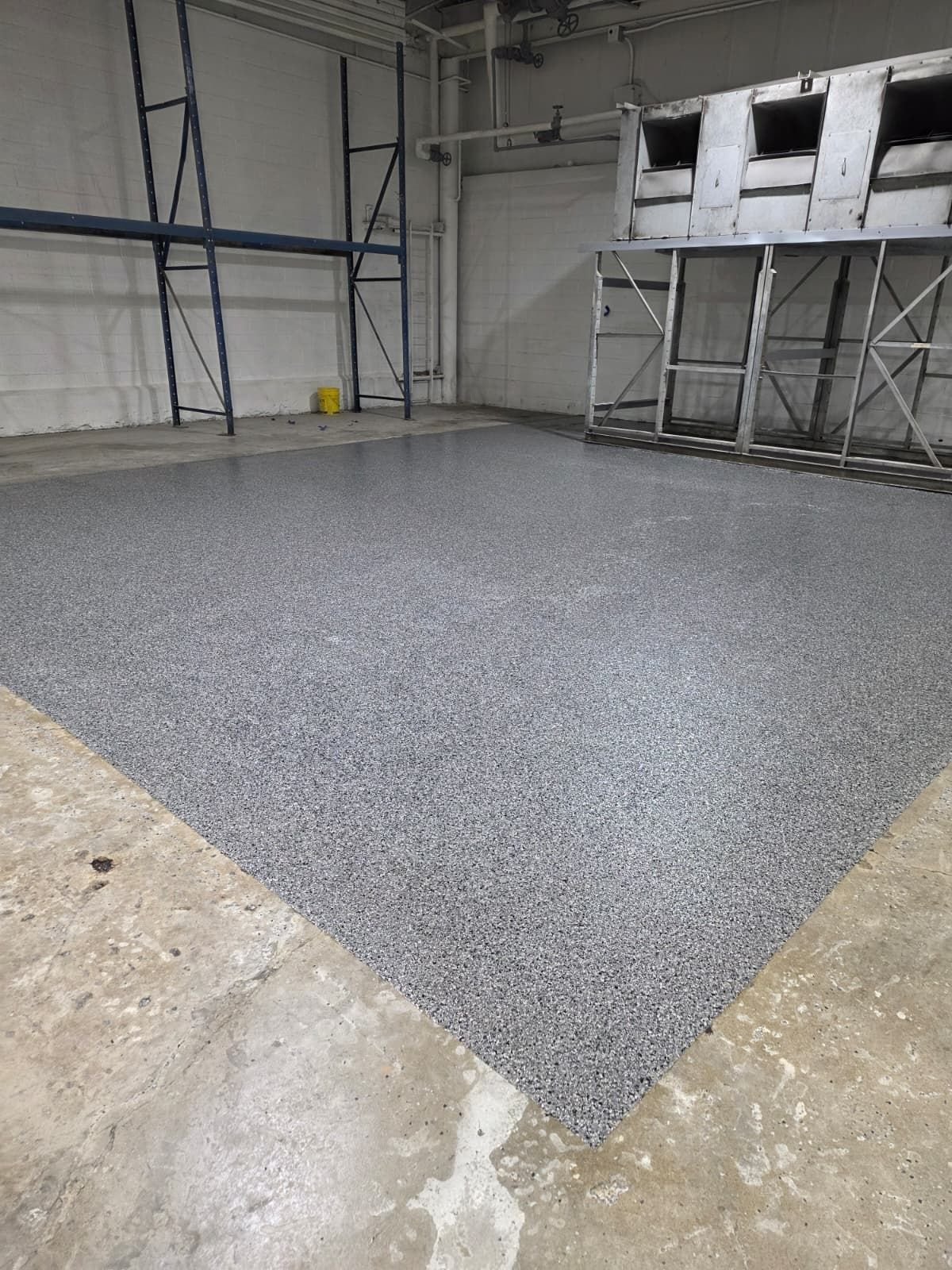
Jack Stands on an Epoxy Garage Floor in El Paso: Will It Dent?
Can you put jack stands on an epoxy garage floor? Yes, once the coating is fully cured. Epoxee installs polyaspartic and epoxy garage floors in El Paso and nearby areas, and the forum reports we found are mixed. One poster’s 3-ton steel-caster jack scratched and dented epoxy, while another left cars on stands for over two years with no dents. A pad under each stand is cheap insurance.
Heavy two-post lifts are a different conversation, and so is welding. We’ll cover both below, plus what old garage forum threads say and who should skip a coating altogether.
Why a small steel foot is harder on a floor than the car’s weight
A car sitting on four tires spreads its load over four patches about the size of your hand. Put the same car on four jack stands and each foot is a few square inches of steel. Same weight, much more pressure at the contact point. A loaded floor jack works the same way, with all that weight riding on a few small wheels.
It’s tempting to quote strength numbers and call it settled. One clear polyaspartic data sheet, the SurfaceOne P97 data sheet (hosted by Runyon Surface Prep), lists compressive strength of 7,500 psi by ASTM C579 and abrasion loss of 30 mg over 1,000 cycles by ASTM D4060. Compressive strength says little about point marking from a steel foot, so treat those figures as a good sign and nothing more.
The sheet gives two cart times. Its table says wheeled carts or liquid cleaning after 8 to 10 hours, while the narrative says 8 to 12. It lists full vehicle traffic after 24 to 48 hours. Check the data sheet for your product and grade before you wheel anything heavy onto a new floor.
Jack stands on epoxy garage floor in El Paso: heat and point loads
El Paso slabs run hot in summer, with 300+ sun days a year and big temperature swings. Hot slabs are why we’d ask about cure time before you load a new floor. The P97 sheet gives an application range of -10 to 85 F, and that limit is the data sheet’s. Ask your installer how they handle a hot slab, and give the floor its full cure before jacks and a loaded tool chest touch it. Our post on how long an epoxy garage floor lasts covers what shortens a floor’s life.
It’s also our inference that a hot film may mark more easily than a cool one. Pad your stands in July.
What garage forum posters report
These are forum anecdotes. In a Garage Journal forum thread from 2010, a 3-ton floor jack with steel casters scratched and dented one poster’s epoxy, and cardboard under it prevented marks. Someone testing Racedeck-type tile, a different material, reported permanent marks from jack stands and a loaded rolling jack, while an unloaded jack was fine. Another poster reported dent-free epoxy after more than two years of cars on stands, and a fourth wrote that any floor suffers under a scissor jack.
A 2016 thread on protecting epoxy turned up pad ideas (Masonite, RaceDeck). One poster there said welding sparks wrecked his epoxy, so if you weld, cover the floor first.
Floor jacks and rolling tool chests
A loaded steel caster is a hard wheel with a narrow contact patch.
- Swap hard steel casters on a tool chest for softer urethane wheels.
- Lift the floor jack to move it a few inches rather than dragging it loaded.
- Slide a strip of thin plywood or rubber under the jack’s wheels while it carries a load.
- Wait out the full cure. Our post on when you can park on a new floor has the timing.
Treat the data sheet’s cart timing as a floor for light stuff, and keep a fully loaded tool chest off the slab a bit longer.
Lifts, anchors and welding
A two-post lift gets bolted down, and the anchors drill straight through the coating into the slab. Ask the lift installer and us before anchoring, and get the slab and anchor requirements in writing first. One forum poster claimed a lift would rip epoxy up “in about 2 cycles.” That claim is unverified, so we wouldn’t repeat it as fact.
Welding is a short story. Cover the floor.
How to protect a floor you’ll work on
If you wrench in your garage, tell us before we quote. It changes how we talk about system choice, and our polyaspartic vs epoxy comparison lays out the differences. My opinion: plan on plywood, Masonite or rubber pads under every stand whichever system you pick, because a scrap of Masonite costs far less than a repair. Those pads are our suggestion.
If a topcoat does get marred, ask us whether a recoat would cover it. Results depend on how deep the mark goes.
When you shouldn’t buy a coating from us
If you drag a loaded steel-wheeled engine stand across the floor every weekend and a single dent would bother you for years, a coating will disappoint you, ours included. Tell us up front and we’ll say so before you spend money. We’d rather have that talk now than at the walkthrough.
Frequently asked questions
Can I put jack stands on an epoxy garage floor?
Yes, once the coating is fully cured. Small steel feet can scratch or dent the film, so put plywood, Masonite or rubber pads under each stand.
Will a floor jack with steel wheels scratch polyaspartic?
It can scratch or dent, as one forum poster reported with a 3-ton jack on steel casters. Softer urethane wheels and a thin pad under the wheels help, and no coating is dent-proof.
Can I install a two-post lift on a coated garage floor?
Ask the lift installer and Epoxee before anchoring. Lift anchors drill through the coating into the slab, so get the slab and anchor requirements first and plan the floor around them.
How long should I wait before using jacks and a rolling tool chest on a new floor?
Wait for full cure. One polyaspartic data sheet lists wheeled carts after 8 to 10 hours and full vehicle traffic after 24 to 48 hours, so confirm timing with your installer and keep heavy steel tools off the floor a little longer.
Planning a floor that has to take a jack? Epoxee installs polyaspartic and epoxy garage floors in El Paso and nearby areas. Call (915) 493-0667 or request a quote, and tell us what lives in your garage.