
Does Epoxy Yellow in the Sun? El Paso Guide
Does epoxy yellow in the sun? Yes, it can. Epoxy ambers over time when UV light reaches it, and the strip of floor nearest the garage door shows it first. A UV-stable topcoat like polyaspartic slows that shift down, which is a big reason we put polyaspartic on El Paso garage floors at Epoxee.
Below we cover why it happens, whether El Paso makes it worse, what you can do about it, and when you can ignore the whole issue.
Why does epoxy yellow in the sun?
UV light changes the resin over time, and the amber tint ends up in the coating itself. It isn’t dirt sitting on top, so a mop won’t fix it.
Not every product behaves the same way. Sherwin-Williams describes its Resuflor UVE, a two-component epoxy, as having a “100% aliphatic or UV-stable formula which helps keep floors from yellowing over time.” Our rule of thumb: if a data sheet doesn’t say the product is UV-stable, ask the installer to show you where it does.
Is El Paso harder on epoxy than other cities?
Probably, yes, though we can’t give you a lab number. El Paso gets 300+ days of sun a year, so a garage floor takes UV almost daily, and the big swings between hot afternoons and cool nights are hard on any coating. The sunniest spot is usually where the door opens. Summer monsoon dust and moisture are the other thing we plan around before any coat goes down.
Here’s where we stand: we won’t install 100% solids epoxy as the final coat outdoors here. Full sun is the one place a cheap epoxy topcoat loses, so exposed patios get a UV-stable topcoat, never a bare epoxy finish.
The door strip matters most. A car drives across it every day, and it sees more light than the back wall ever will.
Take a typical two-car garage of 400 to 500 square feet with a south or west facing door. The back half of the floor may look fine for years while the first few feet inside the door start to warm up in tone. That’s the strip to watch.
Which part of the garage floor yellows first?
The strip nearest the garage door. The door opening is where daylight reaches the floor most directly, so that strip collects the most UV. The rest of the floor gets far less, and any shift there is slower and harder to see.
Is a closed garage door enough?
Not reliably. Daylight can still get in through door windows, gaps and reflections off the driveway. The Sikafloor-340 sheet we cite below also mentions that discoloration can happen under certain artificial lighting conditions, so a closed door isn’t a guarantee.
Can you reverse yellowed epoxy?
We don’t know a reliable way to undo it. The color change is in the coating, so the usual fix is a recoat. That’s why we’d rather you pick the system before the first coat goes down.
How do you stop epoxy from yellowing?
Use a UV-stable system where the sun lands, and ask what’s under the topcoat. At Epoxee that means our polyaspartic topcoat, and our polyaspartic vs epoxy comparison covers the tradeoffs.
The Sikafloor-340 data sheet describes that product as an aliphatic urethane with “excellent UV resistance.” The same sheet says it “will discolor over time when exposed to sunlight (UV) and under certain artificial lighting conditions,” and that use of a “clear UV resistant top coat may not prevent discoloration of underlying coatings.”
Read that as a reason to ask about the whole stack, base coat included.
Will flake hide the color shift?
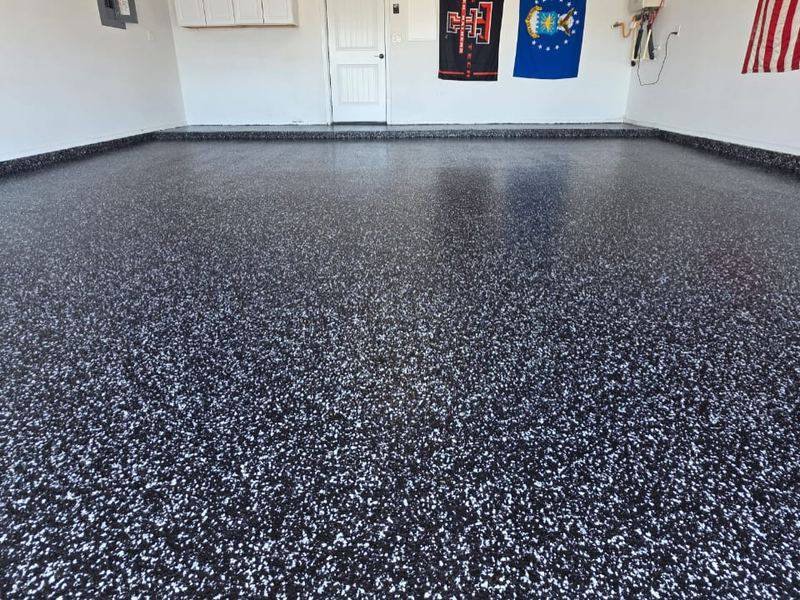
Our view is that it helps. Flakes break up the color, so a slight amber shift in the clear is harder to spot than on a smooth solid-color floor. It won’t stop the shift, though, and it doesn’t replace a UV-stable topcoat.
Color choice plays in too. A pale solid color shows an amber cast more plainly than a busy flake blend.
What should you ask an installer?
Ask what the base coat is, what the topcoat is, and whether each layer is UV-stable. Ask about the door opening specifically, since that’s where the sun hits hardest. And ask how the slab will be prepped, because prep drives both the price and how long the coating lasts.
If you get a vague answer on UV, get a second quote before you sign.
Is your floor already yellowing? Check it this way
Move a mat, cooler or toolbox that has sat in one spot for a few months and compare the covered patch to the floor around it. Then compare the strip at the door to the floor ten feet back.
If the difference is faint, you may be fine living with it. If the door strip is clearly a different color from the rest, that’s the point to price a recoat.
When you can ignore it
The low-risk case is a floor that gets no daylight at all: a fully shaded, windowless interior with nothing coming through gaps or door windows. A utility space where you don’t mind a slight amber cast is another. You’re the one who looks at it every day.
If you’re selling soon, a cheaper system can make sense. That’s your call, and we’ll say so if we think it’s the right one.
What does a garage floor cost in El Paso?
For the whole installed system, we’re talking somewhere between $4 and $13 per square foot depending on prep and system. A topcoat is one layer inside that number, not the whole price. A typical two-car garage of 400 to 500 square feet is about a one- to two-day polyaspartic install. Our guide on how long an epoxy garage floor lasts covers what affects how long a floor lasts, and the garage floor coatings page lists what we install.
Get a UV-stable garage floor in El Paso
Tell us how much sun your garage gets and we’ll tell you straight if you need the upgrade. Request a quote from Epoxee. We serve El Paso and nearby areas.