
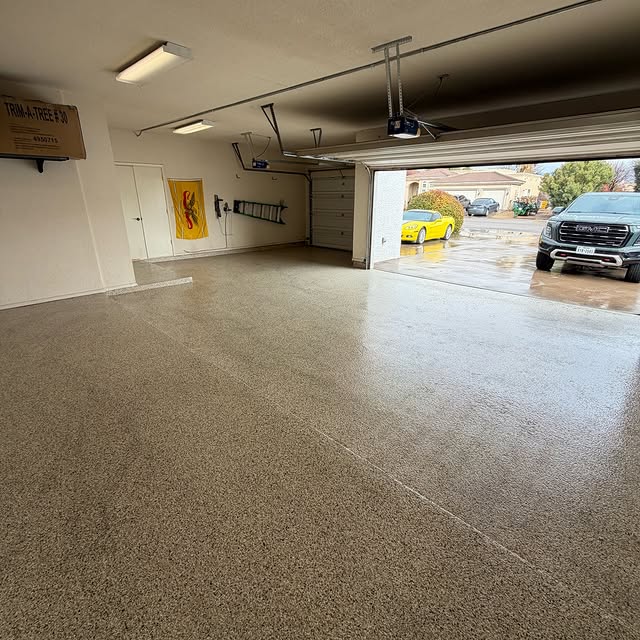
Is It Too Hot to Epoxy a Garage Floor in El Paso?
Every summer the phone starts ringing with the same question: is it too hot to epoxy a garage floor in El Paso, or should you wait for fall? Fair question. Anyone who’s touched a driveway barefoot in July already knows how much heat our concrete holds.
Here’s the honest answer up front. For a garage interior, summer almost never kills the job — it just changes how and when we do it.
When It’s Genuinely Too Hot to Epoxy a Garage Floor
The number that matters isn’t on your weather app. Epoxy cares about the temperature of the concrete itself, and manufacturers publish a window for it: roughly 50 to 90°F at the slab, with 60 to 85°F being the comfortable middle. Even a basic water-based kit like Rust-Oleum’s EpoxyShield lists its application temperature limits right in the technical data sheet, and commercial-grade systems are just as strict.
The catch is that a slab doesn’t track the air. Concrete soaks up heat all day and lets it go slowly, so a slab can run 10 to 20 degrees hotter than the forecast. On a 98°F El Paso afternoon, an exposed slab in direct sun can pass 110°F before lunch. That’s not warm. That’s out of spec for every product we’ve ever installed.
There is one silver lining in desert weather: our big day-to-night temperature swings. Even after a 100°F day, El Paso slabs shed heat overnight, which is exactly why early mornings work.
An infrared thermometer settles the question in two seconds. Point it at the concrete, not the air, and believe what it says.
What a Hot Slab Does to Fresh Epoxy
First casualty: pot life. A 100%-solids epoxy that gives you about 40 minutes of working time at 75°F can drop to under 15 minutes on a 90°F slab; plenty of DIY threads report the bucket starting to gel around the ten-minute mark. The result is roller marks that never flow out, flake broadcast that only covers half the garage, and a coat that goes down thick in one corner and starved in the other. The bond suffers too, because epoxy that’s already gelling doesn’t wet into the concrete the way it should.
Second: outgassing. Concrete holds a surprising amount of air. As the slab heats up, that air expands and pushes out through the surface. Coat while the slab temperature is climbing and those escaping bubbles rise into the wet epoxy, skin over, and cure as pinholes and craters. That’s why pros work early morning or evening, on a falling or stable slab temperature, never at 11 a.m. with the sun ramping up. The American Concrete Institute keeps an entire topic on hot-weather concreting because heat changes how concrete behaves at every stage of its life.
Heat also speeds the cure once the coating is down. Sounds like a bonus, but it shrinks your recoat window, so a two-coat system turns into a race. Cure and return-to-service times are their own topic; we covered when you can park on a new floor separately.
How We Coat Garage Floors Through an El Paso Summer
Interior garages are the loophole. A garage with the door kept down overnight is a big shade structure sitting on cool thermal mass. While the driveway outside is frying, the slab inside is often 25 or 30 degrees cooler.
This past June we did a two-car garage in Socorro, a couple of blocks off Socorro Road. At 9 a.m. the driveway read 117°F on the infrared thermometer. The garage slab, door down since the night before, read 84°F. We’d ground the floor the previous afternoon, started coating at 6 a.m., and had the base coat and flake down by 8:30 with working time to spare.
The rest is process. We check slab temps, not air temps. We start at first light. We run slower summer hardeners so the mix doesn’t cook in the bucket, and we finish with a hot-weather-rated polyaspartic topcoat, which handles our sun and our slab temperatures better than epoxy alone. If you’re weighing the chemistries, we’ve already broken down polyaspartic vs. epoxy for garage floors.
That’s why “wait until fall” is mostly a myth for garage interiors. Epoxee installs year-round in El Paso, July and August included. The calendar doesn’t set the schedule; the slab does.
The Monsoon Wrinkle
July through September adds a second variable: moisture. Monsoon afternoons push the humidity up, and coatings care about dew point as much as heat. If the slab temperature sits within about five degrees of the dew point, condensation can form on the surface and ruin the bond before you ever see it. Storms also build fast out here. We watch the dew-point spread the same way we watch slab temp, and we don’t open buckets with a cell showing up on the radar.
When We’d Actually Tell You to Wait
Now the caveat. An uncovered outdoor slab in direct summer sun is a different animal. Patios, open carports, exposed aprons: those surfaces genuinely can sit above spec from mid-morning to sundown, and even a dawn start leaves a narrow window. On those jobs we’ll coat at first light, watch the forecast for a cooler stretch, or flat-out recommend booking it for fall. Outdoor concrete has its own rulebook, and we walked through it in our post on coating an outdoor patio.
Doing It Yourself This Summer?
A few things that will save your weekend. Keep the kit indoors at 70 to 80°F until the minute you mix; resin that’s been sitting in a hot garage starts the clock early. Coat in the evening once the slab has peaked and started to fall, or at dawn before it climbs. Mix smaller batches than the label suggests and get the material out of the bucket and onto the floor fast, because epoxy left massed in a bucket heats itself. And spend the $25 on an infrared thermometer before you spend $300 on a kit. If the slab reads over 90°F, wait. It’ll drop after sundown.
What a Summer Install Costs
Same as any other season. Garage floor coatings in El Paso run somewhere between $4 and $13 a square foot depending on prep, the system you pick, and the condition of your concrete, which puts a typical 400 to 500 square foot two-car garage between $1,600 and $6,500. Summer doesn’t carry a surcharge; it just means we’ll ask to start early.
If you’d rather have the floor done before the next dust storm than debate slab temps yourself, grab an instant quote or call Epoxee at (915) 493-0667. We’ll come read your slab and give you a straight answer.