
Filling Garage Floor Control Joints: Yes or No?
We get this question on almost every garage floor estimate: those long straight cuts running through the slab every 8 to 12 feet: do we fill them, or leave them alone? Homeowners usually show up having read three different answers online, and all three are half right depending on which joint they’re asking about.
Here’s the short version before we get into the why: at Epoxee, we tell most El Paso customers that filling garage floor control joints (the saw cuts) before epoxying is usually the right call. The true expansion joint where your garage slab meets the driveway apron is a different story, and filling that one solid is where people get into trouble.
Yes, Fill the Saw Cuts. Leave the Apron Joint Flexible.
Saw-cut control joints are shallow, straight cuts made in wet or green concrete to control where the slab cracks as it shrinks while curing, typically about an inch deep and no wider than 3/8″. In a climate like ours, where the ground doesn’t freeze and heave, that joint isn’t doing much work once the slab has cured out. Filling it flush with a semi-rigid filler and coating over it gets you a floor that’s easier to sweep, without a grid of dirt-collecting lines running through it.
The joint where the garage slab meets the driveway apron (or, in some houses, the foundation stem wall) is a different animal: an actual expansion joint, cut deeper and wider on purpose, designed to let two separate pours move independently. Fill that one solid and you’ve removed the one thing keeping it from cracking your coating when the slab shifts.
Control Joints and Expansion Joints Aren’t the Same Cut
This trips up even some flooring salespeople who should know better. Concrete Network’s rundown on control joints, isolation/expansion joints, and construction joints lays out the distinction: a control joint tells the slab where it’s allowed to crack, while an expansion joint separates two slabs entirely so one can move without the other.
None of this is about actual cracks in the concrete. A random crack outside a control joint is a separate problem, covered in our guide on fixing cracks in concrete before coating. Joints are planned; cracks are not, and we treat them differently.
Why This Works Differently in El Paso
Most of the online advice on this topic comes from installers in places with real winters, and that matters more than people think. Freeze-thaw cycles push moisture in and out of a slab and can shift it enough to crack a rigid filler right along the joint line. El Paso doesn’t get that kind of heaving, so a saw-cut joint that’s been sitting still for years generally stays still.
What we do have is caliche soil, which can settle unevenly under a slab, plus day-to-night temperature swings wider than most people expect for a desert. That’s exactly why the apron expansion joint still needs to move: caliche settlement and thermal swing are real, they just don’t show up as cracking along the little saw cuts inside the garage itself.
That’s separate from the coating itself holding up: El Paso gets 300-plus days of sun a year, which is why we spec polyaspartic topcoats over cheap epoxy that yellows under that much UV, regardless of what’s happening at the joints.
What the Forums Actually Say (They Don’t Fully Agree, Either)
A 2022 Garage Journal thread on control joints has a coatings rep from Armorpoxy warning that “the epoxy is hard and not flexible, hence when/if the slabs move you will get cracks along the joints… we normally don’t recommend filling them.” Fair warning in general, and exactly why we don’t apply it to the apron joint.
In that same thread, benwah pushed back: “I fill saw cut joints every time.. Only time I don’t fill is when they are large troweled joints.” FJ4FUN made the more specific point: saw-cut joints, which he put at 3/8″ or less, don’t see the same movement as the bigger troweled joints some builders pour, which is why filling them with a flexible product hadn’t caused him any cracking.
Not everyone frames it around movement, either. In an older Garage Journal thread running from 2015 into 2019, LegacyIndustrial gave advice that lines up almost exactly with ours: “We fill them flush in FL and coat over. If you feel your slab is subject to freeze thaw movement then do not.” Florida and El Paso don’t share much climate-wise, but neither deals with frost heave, which is the whole point.
Expansion joints get the opposite verdict, though. Rugerlady, posting in a third thread specifically about garage-to-driveway expansion joints (2010 to 2020), put it plainly: “We recommend not filling the expansion joints, just painting them.” Chuckw, replying in that same expansion-joint thread, agreed: “I would not fill the expansion joints as they do serve a function if the floor needs to shift.” No contradiction there, just a different joint doing a different job.
The One Joint You Shouldn’t Fill Solid
For the garage-to-apron joint, the fix is a flexible sealant, not just leaving it open to collect gravel forever. Sika’s Sikaflex-1c SL, for example, is a self-leveling polyurethane rated for movement up to plus or minus 25% of the joint width and applied within a 40–100°F range, which covers most of our install season. That kind of flexibility handles the day-to-night swing and the minor settlement that comes with caliche soil without tearing loose the way a rigid filler would.
That’s close to what pauls_workshop described doing in that same expansion-joint thread: coating the floor first, then filling the joint afterward with a flexible sealant rather than baking it into the epoxy system. We follow roughly that same order.
How This Actually Plays Out on a Job
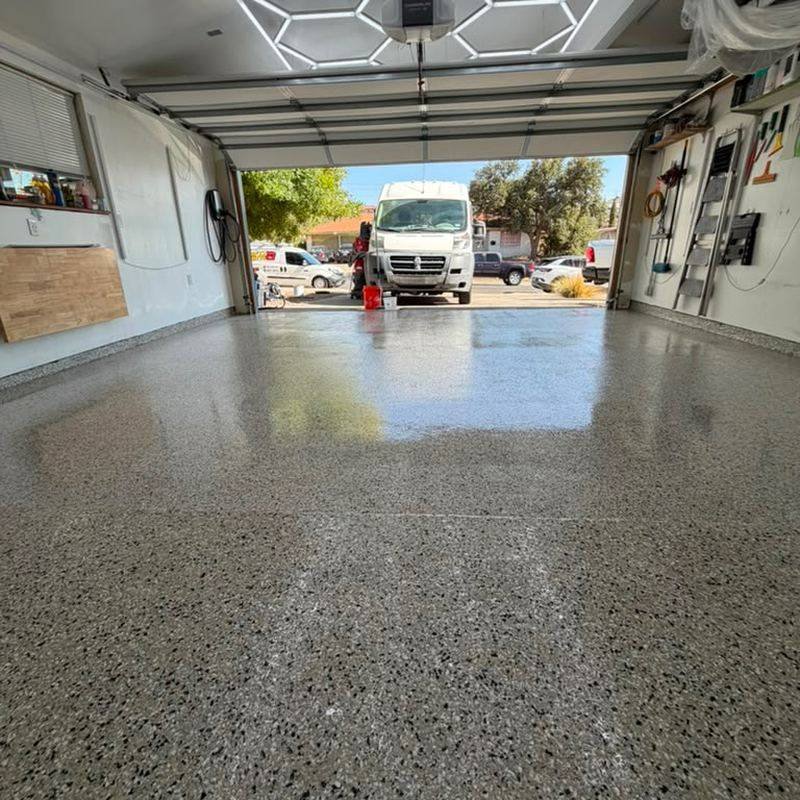
Say you’ve got a typical two-car garage, about 450 square feet, with three saw-cut control joints and one expansion joint where it meets the driveway. On install day, the Epoxee crew grinds the floor, fills the interior saw cuts flush, primes, then lays down a full epoxy and polyaspartic coating system over the whole field, treating the apron joint separately so it stays flexible. Total job time runs about a day and a half, and once it’s done you can’t feel where the interior joints used to be.
One caveat: if your slab has unusually wide or deep troweled joints rather than thin saw cuts, we’ll sometimes recommend leaving those open too, the same logic benwah applied above. A contractor who says it’s always fine without looking at your slab first is guessing.
What to Check For When You’re Comparing Bids
Joint filling is easy for a lowball bid to quietly skip, and you won’t notice until the dust settles in those gaps a year later. Prices around here run somewhere between $4 and $13 a square foot depending on prep and system, and joint filling explains a chunk of that spread. Ask each contractor whether saw-cut joint filling is included, what product they use, and whether the apron joint gets treated separately. Our guide on comparing epoxy garage floor bids covers the rest.
FAQ: Filling Garage Floor Control Joints
Should you fill saw-cut control joints before epoxy coating a garage floor?
In most El Paso garages, yes. Filling garage floor control joints flush with a semi-rigid filler before coating gives you an easier floor to clean and doesn’t create the cracking risk that freeze-thaw climates worry about, since our ground doesn’t heave the way it does up north.
What’s the difference between a control joint and an expansion joint?
A control joint is a shallow saw cut that tells the slab where to crack as it shrinks during curing. An expansion joint is a deeper gap between two separate slabs, like the garage floor and the driveway apron, built specifically to let them move independently.
Can I fill the expansion joint at my driveway apron with epoxy too?
We don’t recommend it. That joint is designed to move with temperature swings and minor soil settlement, so a rigid filler or epoxy tends to crack loose there. A flexible polyurethane sealant applied after the coating holds up much better.
Will filling the saw cuts cause cracking later?
It can in climates with real freeze-thaw cycles, which is why some installers avoid it altogether. El Paso doesn’t get that kind of slab movement, so filled saw-cut joints here typically hold up for years without cracking along the line.
How long does joint filling add to a garage floor coating job?
Not much. On a standard two-car garage, filling three or four saw-cut joints adds maybe an hour to grinding day and doesn’t change the overall one to two day install timeline.
If you’re not sure which joints you’re looking at in your own garage, send us a photo. Call Epoxee at (915) 493-0667 or get a free quote and we’ll tell you straight whether your saw cuts are worth filling before we ever quote the coating itself.