
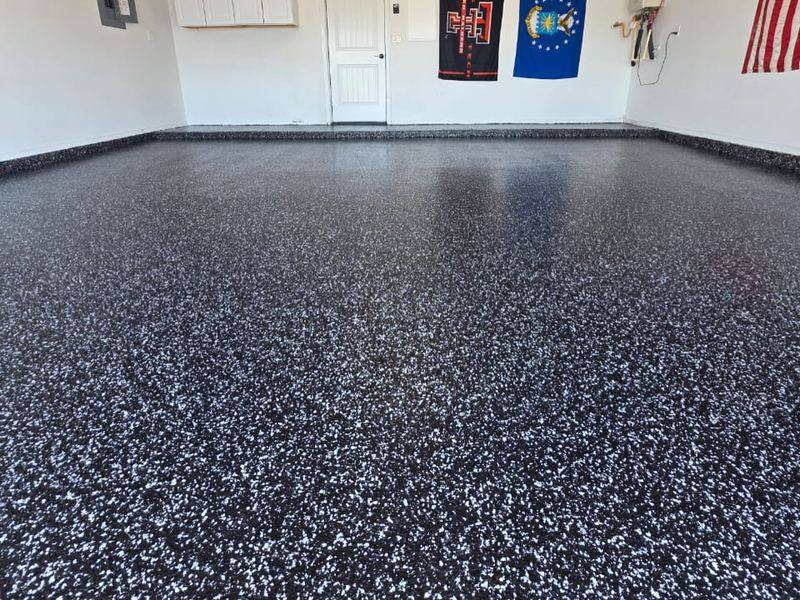
Can You Epoxy a Garage Floor in Winter in El Paso?
Yes, you can epoxy a garage floor in winter in El Paso, and we do it most weeks. The catch isn’t the air temperature, it’s the concrete. Standard epoxy wants the slab at 50°F or warmer during application and the early cure, and a slab that sat through a 34°F night doesn’t hit 50 the minute the sun comes up. So the honest answer is: yes, on the right days, with the job timed around a mid-day slab reading instead of a calendar date.
Fall is prime coating season here, but winter is a better window than most assume.
Yes, You Can Epoxy a Garage Floor in Winter in El Paso, If the Slab Cooperates
The NWS El Paso normals put December highs at about 58°F and lows at about 34°F, and January runs nearly the same. That’s a swing of roughly 25 degrees between 6 a.m. and 3 p.m.
That swing is the whole story. The concrete under your feet spent the night at 34 and warms up a lot slower. A typical attached garage slab climbs into the 50s by late morning or early afternoon. A north-facing detached garage in Chaparral might not get there at all, and Las Cruces, Anthony, and Chaparral all run a few degrees colder overnight than central El Paso. That’s why we walk in with an infrared thermometer before we walk in with a grinder.
What Is the Minimum Temperature for an Epoxy Garage Floor?
For a standard two-part epoxy, 50°F at the slab is the number to hold onto. The Sikafloor-264 product data sheet lists substrate temperature as “Minimum/Maximum 50/85˚F (10/30˚C)” and adds that the “Substrate temperature must be at least 5 ˚F (3 ˚C) above measured Dew Point.” A reply in a 2015 Garage Journal thread titled “Is it too cold for epoxy?” put it plainly: “Rule of thumb is the substrate should be above 50 degrees during application, for a vast amount of epoxies.”
In a 2016 thread, one homeowner said his installer told him a slab temp of 40 or higher would be fine. We don’t work off that number with standard epoxy, and Euclid Chemical’s cold-weather write-up explains why: “most epoxies, unless specifically formulated for cold-weather use, will never fully cure at temperatures below 50° F.” Never fully cured is a floor that peels under the first hot tire in May.
Why the slab temperature matters more than the air
One reply in a 2022 Garage Journal thread got straight to it: “check the slab temperature. It is most important since the coating will quickly take on the same temp as the slab.” Pour 60°F material onto a 42°F slab and within minutes you’ve got 42°F material.
Does Cold Weather Make Epoxy Take Longer to Cure?
Yes, by more than most people expect. The Sikafloor-264 sheet shows foot traffic at roughly 24 hours and full cure around 10 days at 50°F, versus about 12 hours and 7 days at 68°F. Euclid gives the general version of that curve: “for every 18° F drop in temperature below 70° F, the cure time doubles.”
Below the product’s minimum, the math stops helping altogether. As one Garage Journal reply put it, “The curing process slows the colder it gets and will actually stop once it drops below the stated minimum.” Slow is fine. Stopped is a callback.
For the full park-on-it timeline, see when you can drive on your new epoxy floor. Short version for winter: add a day.
Is Winter a Good Time to Get a Garage Floor Coated in El Paso?
Our opinion: yes, and we’d rather coat a floor in January than in late July. Winter here is dry. There’s no monsoon humidity pushing the dew point up and no 100°F slab flashing off the material before it levels. Summer has its own problems, covered in is it too hot to epoxy a garage floor in summer.
A January job in the Upper Valley last winter is a good example. Detached garage, door facing north, pecan trees over the driveway. At 8:30 a.m. the air read 51°F and the slab read 43, so we didn’t touch the material. The crew ground the floor and opened both doors to get sun across the concrete. By 12:45 the slab read 56 and had stopped climbing, so we mixed, then closed up before the sun dropped so the slab held its heat overnight.
Can you coat a garage floor if it freezes at night?
Usually, yes. A low in the low-to-mid 30s is the December normal here, and dips into the 20s aren’t unusual. What matters is whether the slab climbs back above 50 by mid-day and holds there through the first hours of cure. A clear night followed by a sunny day works. Three overcast days after a front, where the slab never leaves the 40s, doesn’t. The morning after a freeze is also when dew point bites, which is why the Sika sheet wants the slab at least 5°F above it.
Do you need to heat the garage?
Not in a normal El Paso winter. Sun and an open door do the work given a few hours. We don’t run heaters on wet coating. Uneven heat gives you uneven cure.
How Epoxee Schedules a Cold Weather Garage Floor Coating
We start later: a 7 a.m. arrival in December is wasted time, so the crew shows up at 9 or 10, preps through the cold part of the morning, and mixes when the infrared thermometer says the slab is ready. We read the slab in several spots, because the back corner can run 5 degrees cooler than the apron. We’ll also ask you to close the garage the night before so the slab doesn’t dump its heat.
A 2015 Garage Journal reply drew the line where we do: “For colder temps you can’t use epoxy. You would need to use a polyurea or polyaspartic coating instead.” It’s why most of Epoxee’s winter floors go down as an epoxy base with a polyaspartic topcoat, or full polyaspartic when the slab reading is marginal. We confirm the exact temperature window for your system on your quote. The full comparison is in polyaspartic vs epoxy for a garage floor.
When We’ll Tell You Not to Book
A few situations where we’ll tell you to wait.
- A front is in the forecast with highs stuck in the 40s. We’d rather slide the date a week than fight the slab.
- Your garage never warms up. Detached, north-facing, and shaded is a tough combination in January, so we check it at a mid-day walkthrough first.
- You need the car in tomorrow. Winter adds a day, and if you can’t spare it, fall or spring is the better call.
- The slab is wet. A floor that sweats on cold mornings is a moisture job first and a coating job second.
None of that rules out winter. It just means we plan it.
A typical 2-car garage here is 400 to 500 square feet, and most jobs land somewhere between $4 and $13 a square foot depending on prep and system. If you’d like Epoxee to read your slab and price it, request a quote or call (915) 493-0667. We serve El Paso, far West Texas, and Las Cruces year-round.
FAQ
What is the minimum temperature to epoxy a garage floor?
For a standard two-part epoxy, the slab itself should be at 50°F or warmer during application and the first hours of cure, and at least 5°F above the dew point. Air temperature is a poor guide because the coating quickly matches the concrete.
Does cold weather make epoxy take longer to cure?
Yes. Manufacturer data for a common floor epoxy shows foot traffic at roughly 24 hours at 50°F versus about 12 hours at 68°F, with full cure stretching from about 7 days to 10. Below the product minimum, cure can stall entirely.
Is winter a good time to get a garage floor coated in El Paso?
Yes. Winter in El Paso is dry, the slab never overheats, and December afternoons average close to 58°F. Overnight lows in the 30s cool the concrete, so mixing gets scheduled around a mid-day slab reading.
Can you epoxy a garage floor if it freezes at night?
Usually, yes. A freezing night followed by a sunny day lets the slab climb above 50°F by early afternoon, which is what the coating needs. A run of overcast days where the slab stays in the 40s is a reason to push the date.
Do you need to heat the garage to epoxy the floor in winter?
Not usually in El Paso. Sun and an open door bring the slab up by mid-day on most winter days, and closing the garage the night before helps it hold heat. Heaters never run on wet coating because uneven heat leads to uneven cure.