
Which Epoxy Garage Floor Color Hides Dirt Best?
The Epoxy Garage Floor Color That Hides Dirt Best in El Paso
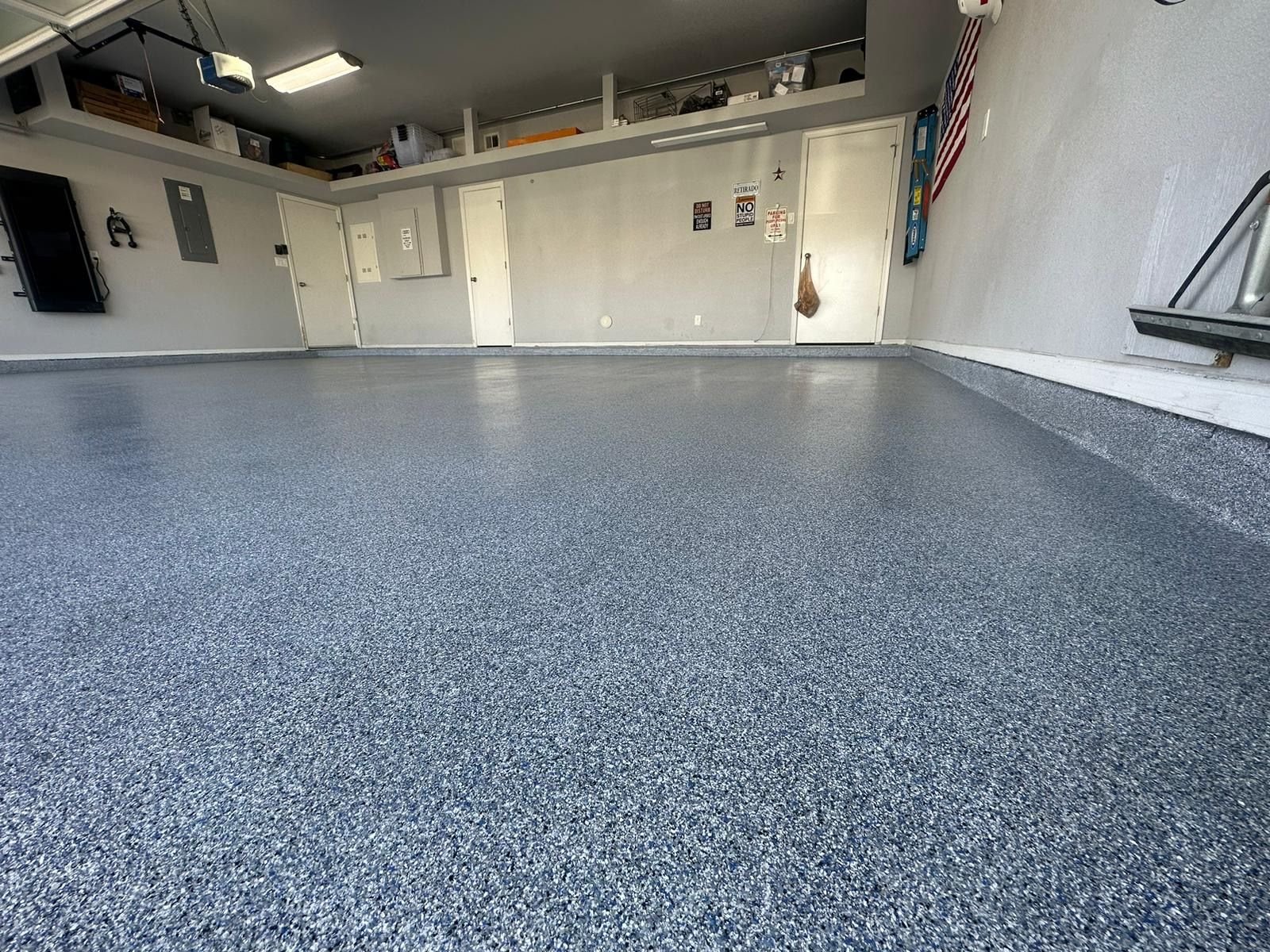
The epoxy garage floor color that hides dirt best in El Paso is a mid-tone flake blend, meaning a tan, gray, or greige base with a mix of light and dark chips broadcast over it. Our dust out here is caliche-colored, a pale tan, and it shows up on a dark floor within a day of a windy afternoon. Solid light floors go the other way: they hide dust but show every tire mark and oil drip. A blend like Gravel, Mushroom, or Dovetail sits in the middle, so dust, water spots, and tire scuff all disappear into the pattern. If you want the single safest pick, go with a full flake blend that’s close to the color of the dirt that blows into your garage.
That’s the short version. The rest of this post walks through what dark and light floors actually do in a desert garage, how full and partial flake compare, which colors make a dropped screw easy to find, and how we help people pick from the 41 blends on the Epoxee colors page.
Does a Dark Epoxy Floor Show Dust and Scratches?
Yes, and in El Paso it shows more than you’d expect. A solid charcoal or black floor looks great the afternoon we finish it. Then the wind picks up, the door goes up and down a few times, and a film of tan dust settles across the whole slab. Every footprint and tire track reads like a stencil. Hard water is the other problem. Our tap water leaves mineral spots when a hose puddle or a dripping A/C line dries, and those white rings are almost invisible on a light floor but jump out on a dark one.
Scratches follow the same rule. A solid color, dark or light, has nothing to break up the surface, so any scuff from a jack stand or a dragged toolbox stays visible. There’s a long thread on Garage Journal where a guy with a dark red-brown solid floor says flat out that it shows everything and he wishes he’d gone gray.
Light solid colors aren’t a free pass either. A white or pale gray floor hides dust well but shows hot-tire marks, oil drips, and the dark ring where the water heater sits. Whichever direction you go with a solid, you’re choosing which kind of mess to look at.
Full Flake vs Partial Flake Garage Floor: Which Hides More?
Full flake wins on hiding, and it isn’t close. In a full flake garage floor the chips are broadcast until the base coat is completely covered, so what you see is pattern edge to edge. Dust, water spots, tire scuffs, and small chips in the coating all get lost in the mix. The layer of chips also adds thickness and abrasion resistance, and it covers minor slab imperfections. A Texas homeowner on Garage Journal passed along a point from a local installer that we agree with: the fewer flakes you put down, the more any future hairline crack or patch in the concrete will telegraph through.
A partial flake garage floor is a lighter broadcast where the base color still shows between the chips. It looks cleaner and more modern to some people, and it’s the compromise pick if you want a light floor for finding parts but still want some camouflage. The trade-off is that the base color is doing more of the work, so a partial broadcast over a dark base still shows dust, and one over a light base still shows tire marks.
Chip size matters too. Our standard install is a 1/4 inch chip, with 1/8 inch and 1/16 inch available. Smaller chips read as a finer texture and a slightly smoother surface; the bigger chip has more grip underfoot. If you’re comparing flake types, the Torginol flake palette is the industry catalog most installers, including us, pull blends from.
On price, color doesn’t move the number. A flake system in a typical two-car garage runs $4 to $13 per square foot installed depending on prep and system, so somewhere around $1,600 to $6,500 for 400 to 500 square feet. The premium mica and marble blends like Geode, Sea Salt, or Onyx may cost a bit more because of the material, but a tan blend and a gray blend price the same.
Which Flake Color Makes Dropped Parts Easy to Find?
If you’re going to be under a car, a solid light gray or white floor makes dropped parts easiest to find. A 10mm socket on a busy flake pattern can hide for a long time, and the Garage Journal thread from a Texas homeowner asking exactly this question landed on the same conclusion: solid light floor first, light base with a light flake broadcast second. A blend like Feather Gray or Silver Bells, where the chips stay in the pale range, keeps enough contrast that a black bolt or a brass fitting stands out while still hiding some dust.
Here’s our honest take. Most people who tell us they need dropped parts easy to find are picturing a project car they’ll work on twice a year, and they’re about to give up a year of dust-hiding for a couple of weekends. Sweep a magnet across the floor and you’ll find the bolt. If you actually wrench every week, or you run a shop, then yes, go light and solid with an anti-slip additive, and keep a shop vac by the door.
Best Epoxy Floor Color for a Hot, Dusty Climate Like El Paso
We did a two-car garage out in Canutillo this spring on a lot that backs up to a dirt road. The homeowner had his heart set on Black Ice, a dark charcoal blend, and we understood why. It looks sharp. So we left three physical samples on his slab for a couple of days: Black Ice, Gravel, and Sand Dollar. When we came back, the Black Ice chip had a visible tan haze on it and the other two looked like they’d just come out of the box. He went with Gravel and later told us he hadn’t swept in three weeks and nobody could tell. That test costs nothing and settles more arguments than any photo.
For most El Paso homes we steer toward warm neutrals or cool grays in a full broadcast. A lot of houses here are tan or beige stucco, and blends like Mushroom, Dovetail, Khaki, or Sunset Beige match the house and match the dirt. If the trim and doors are cooler, Gravel, Stonehenge, or Timberwolf do the same job in gray. A Texas installer in one of those forum threads swears by tan-with-tan flake because it hides dust and mud and also masks the yellowing that hits an unprotected clear coat over time.
With 300-plus days of sun a year, a garage that faces west and a door that stays open, UV matters more here than color does. We finish flake floors with a polyaspartic topcoat rather than a standard epoxy clear. The polyaspartic spec sheet we work from lists it as UV stable and resistant to conventional hot-tire staining, and in our experience that’s what keeps a light or mid-tone blend from going amber at the edge of the door. If you’re weighing the two systems, we wrote up the polyaspartic vs epoxy comparison separately.
When is a mid-tone blend the wrong call? If you want a mirror-black showroom floor and you know you’ll dust-mop it twice a week, get the black floor; you’ll be happier than with a compromise you didn’t want. And if your slab has active cracks from settling, or moisture coming up through it, color is the wrong conversation entirely. That slab needs repair or a moisture-mitigation primer first, and depending on what we find, the right answer may be a different contractor before it’s us.
Still stuck between two blends? Our floor finder narrows it down by house color, garage use, and how much sweeping you’re willing to do.
Ready to see the colors on your own slab? Request a quote from Epoxee or call (915) 493-0667 and we’ll bring physical flake samples out to your garage in El Paso or Las Cruces at no charge. Leave them on the floor for a couple of days and let the dust pick the color for you.