
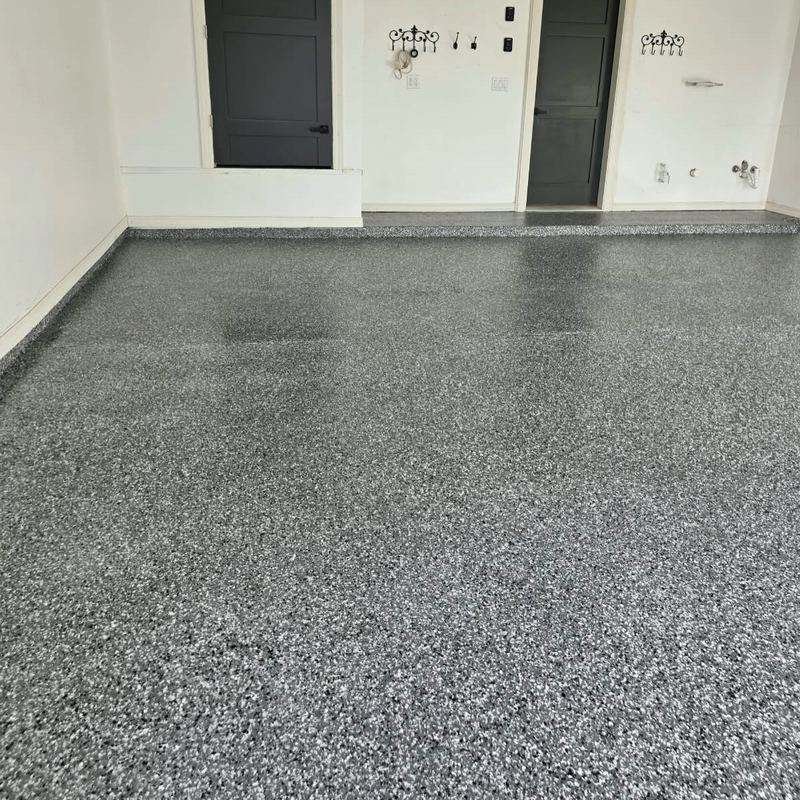
Bubbles in Epoxy Garage Floor: Defect or Normal?
Bubbles in epoxy garage floor coatings are almost always outgassing: air in the concrete’s pores expanded as the slab warmed and pushed through the wet coating before the film could close over it. It looks bad, but in most cases it’s a cosmetic problem, not a bond problem. The one mark that does matter is a raised, soft blister that sounds hollow when you tap it. That’s moisture underneath, and it needs a real fix. Here’s how to tell them apart and why it happens so often in El Paso.
Short answer: it’s usually outgassing, and outgassing typically doesn’t hurt the bond
Concrete is full of tiny air pockets. When the slab warms, that air expands and has one way out: up through whatever’s wet on top. Sherwin-Williams’ technical article on epoxy floor bubbles says outgassing “will almost always show up as a perfect circle with either a ridge around the edge of the circle or as a bubble in the coating.” The same article says those bubbles or craters “typically do not affect the bond strength of the coating.”
So a handful of pinholes isn’t a failed floor. A few hundred is a scheduling mistake, and that’s on the installer.
The look-up guide: what the mark is telling you
A perfect circle with a ridge or a pinhole in the center
That’s outgassing. On a 2015 Garage Journal thread titled “Bubbles on New Epoxy Floor,” a homeowner three days past a pro install was told by his installer that “it is just the floor breathing.” A replier wrote that “This is called outgassing. When the temperature of the concrete is rising it out gasses.” The floor does breathe when it warms. You just don’t coat it mid-breath.
Pinholes that follow the concrete’s own pores
Some pinholes in epoxy floor coatings were already in the slab. On a 2021 Garage Journal thread, a DIYer noticed “the holes stand out and appear much more prevalent than I’d realised.” Another member explained those “are the weep holes of the water that came to to the top concrete as it cured. Grinding opened them up and the epoxy ran down into the hole.” A porous slab needs a primer or fill coat first.
Clusters of tiny bubbles across a whole section
Small, dense bubbles in a band about a roller wide are air whipped in during mixing or rolling. Sika’s Sikafloor-264 data sheet puts it plainly: “Over-rolling and late back rolling may cause bubbling and leave roller marks.”
Fisheyes: round thin spots where the coating pulled away
The coating crawled away from a spot it couldn’t wet out, usually oil or silicone. The 2015 replier who named outgassing also noted “oil contamination would ‘fisheye’ not blister and pop.” Sand, clean, recoat.
A raised, soft blister that sounds hollow when you tap it
This is the one that matters. Craters are open and hard. A blister is closed, domed, and soft under your thumb. Sherwin-Williams’ blistering article calls raised, hollow-sounding spots disbondment, usually moisture vapor from under the slab. It gets cut out and redone. If one has already lifted, you’re into fixing a peeling epoxy garage floor.
Why El Paso slabs outgas more than most
We get 300-plus days of sun and a big day-to-night temperature swing. The crew rolls up the door at 7 a.m. to grind, when the slab is coolest. By 10, sun is pouring through that open door onto the front of the slab, and it climbs until mid-afternoon. Wet coat on top? It vents. That’s why bubbles in epoxy garage floor coatings around here cluster in the first 8 or 10 feet inside the door.
Sika’s Sikafloor-264 product data sheet lists it under Limitations. “Do not apply while ambient and substrate temperatures are rising, as pinholes may occur. Ensure there is no vapor drive at the time of application.” The key word is rising. That sheet also caps substrate temperature at 85°F. An 80°F slab that’s plateaued behaves. A 65°F slab on its way to 80 pinholes.
How Epoxee schedules around slab temperature in El Paso
We coat on a plateaued or falling slab, never a warming one. We grind in the morning, then put an infrared thermometer on the front of the floor every half hour until it stops climbing. In summer the primer often waits for mid-afternoon, or we shut the door and work under lights. Winter flips the problem to dew point, covered in our post on coating a garage floor in winter.
Priming is the other half. A thin primer seals the pores under a cured film, so air that expands later has a much harder time pushing through wet color. Skip it to save a step and you’re betting the color coat on the slab holding still.
Last summer we did a two-car garage in the Northeast off Dyer with a west-facing door. The slab jumped close to 20 degrees before our first temp check. We closed the door, held the primer until three, and rolled color as the slab fell. No craters.
What a good installer does about it
Scattered pinholes get sanded, spot-filled with topcoat, and blended. A band or cluster gets sanded and recoated. Pinholes across most of the floor usually mean the coating went on a climbing slab or an unprimed porous one, and the honest fix is a full sand and fresh topcoat on the installer’s dime.
The homeowner on that 2015 thread came back, said he’d “now noticed a ton of indentions,” and was calling the installer. Right move. A recoat is real money on a floor that ran $4 to $13 a square foot depending on prep and system, so we’d rather wait three hours than lose a day. Our guide to comparing epoxy garage floor bids covers what to ask before you sign.
When not to worry, and when to call
Don’t lose sleep over a few pinholes you have to hunt for, or craters at the threshold where the sun hit. They rarely spread.
Call when pinholes cover most of the floor, when new ones keep appearing after the coating has hardened, or when anything is raised and soft. That last one is moisture, and moisture doesn’t fix itself.
Are bubbles in epoxy garage floor coatings a defect?
A few of them, no. They’re a cosmetic side effect of coating concrete that hadn’t finished warming, and the bond underneath is typically fine. A floor covered in them is a workmanship defect. Same mark either way. The quantity tells you whose problem it is.
Will pinholes in epoxy floor coatings get worse over time?
Outgassing pinholes set when the coating hardens. They typically don’t grow or hurt the bond, but an open pinhole collects dirt and water, so have them filled while the installer still owes you a callback. Blisters are the opposite and spread as moisture keeps working underneath.
Can I fix epoxy floor outgassing myself?
On a small area, yes, with leftover topcoat from the same batch. Sand the craters flat, wipe the dust, and brush a thin coat over the spot. Anything bigger than a couple of square feet is the installer’s job.
Frequently asked questions
What causes bubbles in a new epoxy garage floor?
Almost always outgassing. Concrete holds air in its pores, and when the slab warms while the coating is still wet, that air expands and pushes up through the film, leaving a crater or pinhole.
Are outgassing pinholes covered under warranty?
A handful near the door is cosmetic, and most installers, including us, touch them up as a courtesy. Pinholes across most of the floor usually mean the coating went down on a warming or unprimed slab, and a good installer recoats at no charge.
How can I tell outgassing from a moisture blister?
Tap it. An outgassing crater is open, hard, and level with the floor. A moisture blister is closed, domed, soft, and hollow-sounding, and it usually appears weeks later. Blisters mean the coating has let go and needs to be redone.
Does a primer stop epoxy floor outgassing?
It helps a lot. A thin primer seals the pores under a cured film, so air that expands later stays behind that film instead of pushing through wet color. Primer alone on a climbing slab can still pinhole, so pair it with a plateaued or falling slab.
What time of day should epoxy go down in El Paso?
Whenever the slab has stopped climbing. In summer that usually means mid-afternoon, or with the door shut and lights on. We check with an infrared thermometer, because a slab on its way up pinholes and a plateaued slab usually does not.
Got craters? Get a second set of eyes
Not sure which kind you’ve got? Send Epoxee a few photos from anywhere in El Paso or Las Cruces and we’ll tell you straight whether it’s a touch-up, a recoat, or a moisture problem, even if we didn’t install it. Request a quote or call (915) 493-0667.